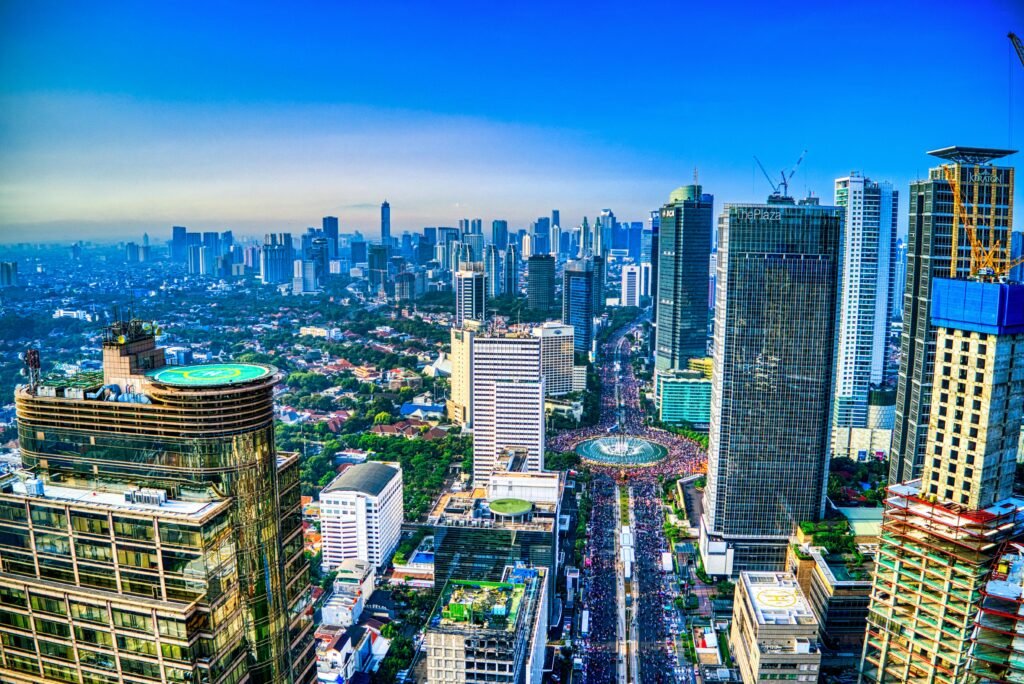

Thailand digital economy, industrial, future economy growth 2026.
Executive Overview
Thailand is executing a comprehensive economic transformation strategy, transitioning from a low-cost manufacturing hub into a high-value innovation economy. Through its flagship “Thailand 4.0” initiative and the Bio-Circular-Green (BCG) economic model, the country is simultaneously pursuing growth across six interconnected sectors: electric vehicles, digital economy, biotechnology, sustainable industries, high-value tourism, and regional logistics. With foreign direct investment surging 35 percent to 1.13 trillion baht ($33 billion) in 2024 and deliberate policy incentives attracting global companies, Thailand is positioning itself as Southeast Asia’s strategic economic engine.
1. Electric Vehicles & Smart Electronics: The “Detroit of Asia”
Market Position and Investment Inflows
Thailand has emerged as Southeast Asia’s primary manufacturing platform for electric vehicles, attracting unprecedented investment from Chinese, Japanese, and international automakers. The country aims to achieve the “30@30” target—converting 30 percent of its annual vehicle production to EVs by 2030, translating to 725,000 cars and 675,000 motorcycles annually. Chinese EV manufacturers have led the investment wave, with combined commitments exceeding $1.4 billion. BYD alone opened a Rayong facility in July 2024 with 150,000 units per year capacity, serving Asian markets while potentially circumventing EU tariffs through right-hand-drive production. Great Wall Motor is investing up to $30 million to establish a battery pack assembly plant in Thailand, with plans for a dedicated research and development center focused on battery-powered vehicles. GAC Aion and Chery are similarly establishing manufacturing footprints in the Eastern Economic Corridor (EEC).
Policy Framework: The EV3.5 Scheme
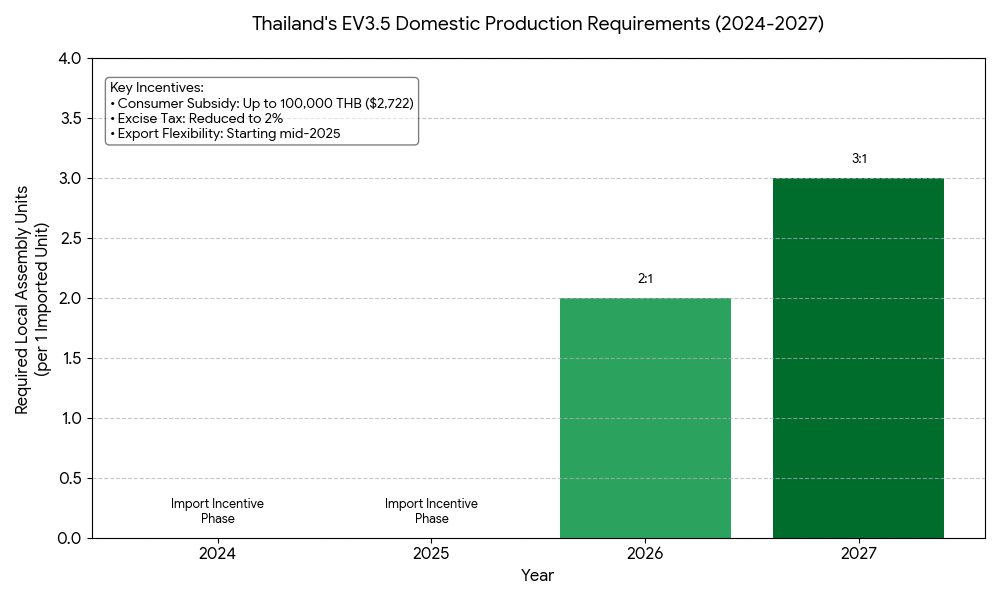
Thailand’s EV3.5 package (2024-2027) represents one of the region’s most aggressive incentive structures. Consumer subsidies reach 100,000 baht ($2,722) for mass-market electric vehicles with battery capacity exceeding 50 kWh, with a reduced excise rate of 2 percent on eligible battery electric vehicles. Import duty reductions apply during 2024-2025, creating financial pressure on importers and driving domestic production commitments. From 2026 onward, manufacturers must assemble two vehicles in Thailand for every imported unit, rising to a 3:1 ratio by 2027. Since mid-2025, the government permits exports of locally built EVs to count toward these obligations, offering manufacturers greater flexibility.
Battery Manufacturing Ecosystem
Recognizing that domestic battery production is essential for competitive advantage, Thailand approved a $1 billion investment from Chinese battery manufacturer Sunwoda in March 2025. The first factory in Chonburi Province will produce lithium-ion battery cells, creating over 1,000 jobs and representing Sunwoda’s first ASEAN-region EV battery cell facility. Other local players include Gotion and PTT, which have begun module production. Thailand’s discovery of approximately 15 million tonnes of lithium deposits provides additional leverage for attracting battery technology investments. Thailand digital economy, industrial, future economy growth 2026.
Smart Electronics and 5G Integration
Beyond automotive, Thailand is positioning itself as a smart electronics hub. The Midea Group, China’s major electrical appliance manufacturer, opened a 5G-powered factory under the ECC—a landmark facility demonstrating ultra-low latency production through integrated IoT, advanced robotics, and AI-powered quality control systems. This 5G infrastructure deployment, supported by partnerships between Ericsson, Thailand’s Digital Economy Ministry (depa), and private operators, is enabling manufacturers to validate production-grade deployments.
Semiconductor Specialization
Thailand ranks 6th globally in semiconductor device exports ($9.6 billion+ in 2024), with particular strength in assembly, testing, and packaging (ATP) operations. Major integrated device manufacturers including Infineon, NXP, Microchip, and Analog Devices maintain assembly and testing facilities in the country. In January 2026, Thailand unveiled a National Semiconductor and Advanced Electronics Strategy targeting power semiconductors, sensors, photonics, discrete devices, and analog chips—segments closely aligned with the automotive, energy, and data center industries. This selective focus leverages Thailand’s established manufacturing base rather than attempting compete in capital-intensive wafer fabrication.
2. Digital Economy: From Cashless Society to E-Commerce Powerhouse
PromptPay: Foundation of Digital Finance
PromptPay, Thailand’s real-time payment infrastructure launched in 2016, has fundamentally reshaped the country’s financial ecosystem. With 81 million registered users as of March 2025, it effectively encompasses nearly Thailand’s entire eligible population. The system enables instant peer-to-peer transfers using phone numbers or national ID numbers, eliminating the need for complex bank details. Mobile banking accounts surged to 165.3 million as of September 2025, up from 136 million in 2023. This infrastructure has accelerated Thailand’s shift toward a cashless society—the average Thai user completed 538 digital transactions in 2023, rising to approximately 700 annually by 2025. PromptPay’s convenience has particularly benefited small and medium-sized enterprises, enabling merchants to accept digital payments via QR codes without expensive terminal equipment.
E-Commerce Market Expansion
Thailand’s e-commerce sector has exhibited counter-cyclical growth, expanding robustly despite broader economic headwinds. The market reached 1.1 trillion baht in 2024 (up from 980 billion baht in 2023) and is projected to attain 1.6 trillion baht by 2027, positioning Thailand as ASEAN’s second-largest e-commerce market behind Indonesia. Shopee and Lazada dominate with combined market share exceeding 79 percent, though TikTok Shop has emerged as a disruptive challenger. Shopee’s 2024 performance was historically strong, generating 49.96 billion baht in revenue with profits exceeding 4.63 billion baht—the platform’s most successful year in Thailand since launch. Lazada generated 28.29 billion baht in revenue with 836 million baht in profit during 2025.
Digital Payments Infrastructure Extension
Thailand is piloting cross-border QR code payments with neighboring countries, enabling Thai tourists to use local payment apps in Singapore, Malaysia, and Indonesia. The Bank of Thailand granted virtual banking licenses, enabling tech-driven banks to operate without physical infrastructure. These initiatives position Thailand as Southeast Asia’s digital payments leader, with regulatory frameworks supporting innovation while maintaining security and consumer protection.
3. Biotechnology, Medical & Wellness Tourism: Leveraging Comparative Advantage
Medical Tourism Market Dynamics
Thailand’s medical tourism sector has evolved into a major economic driver, valued at $31.5 billion in 2024 with projected growth to $110.1 billion by 2034 (13% CAGR). The country hosts 61 hospitals certified by the Joint Commission International (JCI), signaling world-class medical standards. Medical procedures cost 30-70 percent less than in Western countries, and over 500 hospitals and clinics nationwide serve international patients. The Tourism Authority of Thailand (TAT) is targeting 125 billion baht in medical and wellness tourism revenue by 2026, specifically emphasizing elderly long-stay visitors as a high-spending demographic. Thailand digital economy, industrial, future economy growth 2026.
Aesthetic Medicine: A Distinct Growth Segment
The aesthetic medicine market, valued at $1.61 billion in 2024, is projected to reach $3.12 billion by 2030 (11.6% CAGR). Thailand operates approximately 7,000 aesthetic clinics, with 2,000 concentrated in Bangkok and 5,000 across provinces. Invasive procedures dominate the market (71.98% share in 2023), as procedures like rhinoplasty and breast augmentation cost 20-65 percent less than in Western countries. The country attracts 2.5 million medical tourists annually, with 60 percent visiting specifically for cosmetic procedures.
Wellness Tourism and Longevity Services
Thailand’s wellness ecosystem extends beyond traditional medical tourism. Facilities such as Chiva-Som, Kamalaya, and RAKxa have repositioned themselves as comprehensive wellness destinations, integrating functional medicine, traditional Thai massage, nutrition counseling, and psychological support. Wellness tourism spending more than doubled from 2022-2023, representing a 28.4 percent recovery rate—among the world’s fastest. This sector addresses growing global demand for preventive care, stress management, and longevity-focused treatments, attracting affluent wellness tourists alongside medical tourists.
Functional Foods and Nutraceuticals
Thailand is transitioning from commodity agricultural export focus to high-value functional food production. The government targets a 500 billion baht “Future Food” market by 2027 (220 billion baht in exports, 280 billion baht in domestic sales). The FDA is establishing a Positive List of 150+ certified safe ingredients by 2027, reducing R&D costs by over 70 percent for companies developing functional foods. This initiative addresses global demand for foods engineered with specific health benefits—prebiotics, omega-3s, plant-based proteins—leveraging Thailand’s agricultural biodiversity and processing infrastructure. Plant-based protein markets reached $1.5 billion in 2024 with projected annual growth rates of 35 percent.
4. Sustainable Industries: The Bio-Circular-Green Economic Model
BCG Framework and Strategic Sectors
Thailand’s Bio-Circular-Green (BCG) economic model represents a fundamental strategic reorientation toward sustainability and value creation. Introduced by the Thai government as a post-pandemic recovery strategy, the BCG model emphasizes applying science, technology, and innovation to transform Thailand’s biological and cultural diversity into competitive advantage. The model focuses on four strategic sectors: agriculture and food, wellness and medicine, energy/materials/biochemicals, and tourism/creative economy.
Renewable Energy Integration
Thailand is accelerating its transition to renewable energy, targeting 31 percent renewable capacity by 2025 and 40 percent by 2035. As of 2024, renewables generated 10 percent of grid power, doubling from 2015 levels. Solar and biomass account for 69.4 percent of renewable capacity, wind power contributes 19.7 percent, while biogas, waste-to-energy, and small-scale hydro represent 10.9 percent. The government has implemented feed-in tariffs, tax incentives, and subsidies for renewable projects, with the Electricity Generating Authority of Thailand (EGAT) raising funds through sustainability-linked bonds. Key challenges include energy storage capacity for variable renewable sources and infrastructure upgrades to accommodate increased solar and wind integration.
Bioplastics and Circular Economy Development
Thailand’s abundant agricultural feedstocks—particularly cassava and sugarcane—position it as a bioplastics production hub. Total Energies Corbion has invested since 2019 to establish a 75,000-ton-per-year polylactic acid (PLA) production facility, driving export growth. Bioplastics exports have grown at 25 percent CAGR, though consumption remains limited relative to capacity. The government’s Extended Producer Responsibility (EPR) and circular economy frameworks are directing plastic waste toward recycling and chemical recovery rather than landfills.
Agriculture Modernization: Precision Farming and Sustainability
Thailand’s agricultural sector is undergoing technological transformation through the “Agriculture 4.0” initiative, launching January 15, 2026. This comprehensive strategy integrates smart farming technologies—sensors, drones, data-driven irrigation systems, and automated machinery—to enhance productivity and sustainability. The government has committed significant funding for equipment subsidies and training programs, ensuring accessibility for small-scale farmers. Precision farming applications have demonstrated yields of 15-20 percent in sugarcane operations, leveraging AI-driven spectral analysis and IBM’s Watson Decision Platform.
5. High-Value Tourism and MICE: Beyond Mass Market
MICE Industry Expansion
Thailand’s Meetings, Incentives, Conferences, and Exhibitions (MICE) sector was valued at $4.3 billion in 2024 and is projected to reach $13 billion by 2033 (10.3% CAGR). The sector benefits from Thailand’s strategic geographical location within Southeast Asia, world-class convention centers, and state-of-the-art hospitality infrastructure. The Queen Sirikit National Convention Center and associated facilities host major international events. Thailand MICE Exchange 2026 (TMX 2026), scheduled for April 29-30, 2026, is expected to attract 4,000+ delegates and over 100 exhibitors, reinforcing Thailand’s position as a regional events hub. Thailand digital economy, industrial, future economy growth 2026.
Luxury Golf and Adventure Tourism
Thailand’s golf tourism segment has matured into a premium sector attracting high-spending international travelers. The country operates over 250 golf courses designed by world-renowned architects including Jack Nicklaus and Greg Norman. Championship courses such as Siam Country Club host major international tournaments including the Honda LPGA Thailand. Luxury resort bases such as Black Mountain Golf Club in Hua Hin integrate golfing with premium accommodations, spa services, and curated dining experiences—typically 30-50 percent cheaper than comparable European or Caribbean destinations. Phuket, Bangkok, and Hua Hin serve as primary golf tourism hubs, combining course quality with beachfront luxury and cultural immersion.
Wellness and Longevity Tourism
As distinct from medical tourism, wellness tourism caters to affluent travelers seeking preventive health, burnout recovery, and longevity-focused treatments. Millennials and Generation Z are increasingly adopting wellness-centered short breaks alongside traditional older demographics. Thailand’s positioning as “Top Global Spa & Wellness Destination” at the Hospitality Horizon Spa & Wellness Summit & Awards 2025 reflects this evolution. The global wellness tourism market is expected to expand from $1.21 trillion (2025) to $3.27 trillion by 2035.
6. Logistics and Regional Trade: The Eastern Economic Corridor
Strategic Infrastructure Development
Thailand’s Eastern Economic Corridor represents a comprehensive infrastructure transformation worth 652 billion baht ($18.3 billion) in announced investments. The EEC spans Chonburi, Rayong, and Chachoengsao provinces, leveraging strategic positioning alongside the Gulf of Thailand and proximity to Bangkok’s international airport and container port.
Port Development: Laem Chabang, Thailand’s primary container port, handled 9.46 million TEUs in 2024, up from 8.67 million TEUs in 2023. Phase 3 expansion will construct deep-water berths across 1,600 rai (256 hectares), targeting completion by 2027. Map Ta Phut Industrial Port Phase 3 expansion will develop terminals for natural gas and liquid materials, handling 31 million tonnes of cargo annually by 2027.
Air Connectivity: U-Tapao International Airport expansion will construct passenger terminals, a second runway, cargo logistics centers, and an aviation training center, ultimately handling 60 million passengers annually upon completion in 2029.
Rail Infrastructure: High-speed rail will connect Thailand’s three major international airports—Don Mueang, Suvarnabhumi, and U-Tapao—reducing travel times to under one hour. Double-track railways will link Laem Chabang port to regional industrial centers. The Thailand-China Railway project (873 kilometers) will connect Bangkok to the Laos-China railway system, enhancing connectivity to mainland Southeast Asia and southern China. Completion is targeted for 2028.
Land Bridge Megaproject: The Southern Economic Corridor’s Land Bridge Project represents a transformative infrastructure development, constructing two ports on opposite coasts, a six-lane motorway, double-track railway, and service roads to redirect cargo flows and reduce transport times.
Supply Chain Integration and Trade Performance
Thailand’s export performance reflects its integration into global value chains. In 2024, the country exported $299.24 billion of goods (fourth-largest in ASEAN), driven by automotive, electronics, food processing, textiles, and emerging sectors including EV components, medical devices, and aerospace parts. Exports represented approximately 65 percent of GDP in 2023.
Key Export Segments:
- Automotive & EV Components: Concentrated in the EEC, serving Japanese and emerging Chinese manufacturers
- Electronics & Semiconductors: $75 billion+ in 2024 exports; 6th globally in semiconductor device exports ($9.6 billion)
- Agricultural Products: $52.19 billion combined exports (+6% YoY)
- Rice: 9.2 million metric tons ($6.82 billion)
- Canned tuna: $2.49 billion (25% global market share)
- Durian: $3.82 billion (50% global market share)
- Natural rubber: $4.97 billion (+37.3% YoY)
- Halal products: $7.13 billion (+6.3% YoY)
- Textiles & Technical Materials: Shifting from commodity garments to specialized fabrics and performance materials
Regional Economic Integration
Thailand’s participation in the ASEAN Economic Community (AEC) and the Regional Comprehensive Economic Partnership (RCEP) facilitates integrated regional value chains. Manufacturers leverage RCEP’s cumulative rules of origin to source inputs from Vietnam or southern China, assemble in Malaysia, and complete high-value manufacturing stages in Thailand. This model minimizes tariffs while enhancing operational agility and supply chain resilience. FDI inflows surged 35 percent to 1.13 trillion baht ($33 billion) in 2024, with tech-intensive sectors (data centers, semiconductors, smart manufacturing) dominating investment approvals.
Strategic Interconnections and Competitive Advantages
Integrated Value Chain Ecosystem
Thailand’s six strategic sectors function as an integrated ecosystem rather than isolated initiatives. EV battery manufacturing (sector 1) draws on medical device manufacturing expertise (sector 3) in clean-room production standards. Bioplastics and functional food development (sector 4) support medical tourism through wellness product offerings (sector 3). MICE infrastructure (sector 5) facilitates technology transfer and knowledge exchange across sectors. Logistics infrastructure (sector 6) enables export of completed EV systems, medical devices, and functional food products to regional and global markets.
Competitive Positioning Against Regional Peers
Thailand’s strategic positioning differs from regional competitors:
- Vietnam: Labor cost advantage but less developed infrastructure; Thailand emphasizes high-value assembly and innovation
- Malaysia: Semiconductor strengths but smaller agricultural base; Thailand leverages agri-biotech integration
- Singapore: Financial services hub but limited manufacturing; Thailand complements as a production platform
- Indonesia: Larger domestic market but fragmented infrastructure; Thailand offers logistics centrality Thailand digital economy, industrial, future economy growth 2026.
Risk Factors and Mitigation Strategies
Geopolitical Risk: The concentration of Chinese EV investment creates potential supply chain vulnerabilities. Thailand’s government has diversified through Japanese and international automaker engagement while maintaining neutrality in U.S.-China trade dynamics.
Energy Security: Renewable energy targets require substantial battery storage investment and grid modernization. The government is funding R&D into advanced storage technologies and pursuing regional energy integration through cross-border interconnections.
Technological Capability Gap: Precision farming and semiconductor sectors require continuous skills development. Government programs and university partnerships address workforce needs through training and research collaboration.
Global Trade Volatility: Exports represent 65 percent of GDP, creating vulnerability to tariff fluctuations and demand shocks. Regional diversification and value chain upgrading reduce this exposure over time.
Conclusion: Thailand’s Economic Transformation Trajectory
Thailand’s strategic initiatives represent a comprehensive attempt to elevate the nation from low-cost manufacturing toward high-value innovation and sustainability. The simultaneous pursuit of EV manufacturing dominance, digital finance leadership, medical tourism excellence, sustainable circular economy development, premium tourism experiences, and regional logistics centrality creates multiple reinforcing growth pathways.
Success depends on executing coordinated policy implementation across sectors, maintaining infrastructure investment discipline, developing skilled workforces, and leveraging geopolitical positioning as a stable, investment-friendly Southeast Asian hub. The 35 percent surge in FDI inflows, combined with government policy consistency and private sector engagement, suggests Thailand is successfully attracting global companies seeking alternatives to China and diversified production bases.
By 2030, if current initiatives maintain momentum, Thailand could emerge as Southeast Asia’s preeminent innovation economy, combining manufacturing excellence with digital sophistication, medical expertise, agricultural biotechnology, sustainable energy production, and premium service experiences—a transformation from “Detroit of Asia” to “Singapore of Southeast Asia” in strategic capability and per-capita economic value creation.
official Thailand government websites
| Board of Investment (BOI | Board of Investment (BOI |
| Eastern Economic Corridor Office | Eastern Economic Corridor Office |
Read more country case studies done before this.
| Qatar | Qatar |
| Pakistan | Pakistan |
| iran | iran |
| bangladesh | bangladesh |
| china | china |
| Indonesia | Indonesia |
| hong kong | hong kong |
| japan | japan |
| sinagpore | singapore |
| taiwan | taiwan |
| uAE | UAE |
| vietnam | vietnam |
| saudi arbia | saudi arbia |
| Malaysia | Malaysia |
| india | india |
| south korea | south korea |