Table of Contents
Meta Platforms Superintelligence Infrastructure Strategy 2026
1. Company Overview
| Company Name | Meta Platforms, Inc. |
| Founded Year | 2004 (as Facebook, Inc.; rebranded to Meta in 2021) |
| Industry / Sector | Social Media, Artificial Intelligence, Digital Advertising, Extended Reality (AR/VR), Consumer Technology |
| Headquarters | Menlo Park, California, United States |
| Company Revenue | USD 135 billion (FY 2023–2024 approx., advertising-led) |
| Founders | Mark Zuckerberg Eduardo Saverin Andrew McCollum Dustin Moskovitz Chris Hughes |
| Company Type | Public Company (NASDAQ: META) |
| Products / Platforms | Facebook Messenger Threads Meta AI Llama (Open-Source AI Models) Quest (VR Headsets) Horizon Worlds (Metaverse Platform) |
| Target Market | Global Consumers (Social, Messaging, Content) Advertisers & Brands Developers & AI Researchers Creators & Influencers Enterprises (AR/VR, AI tools) |
| Market Role | Global social media leader transitioning into a large-scale AI and superintelligence infrastructure provider |
| Unique Value | 1. Planet-scale social graphs and data 2. Open-source AI leadership via Llama 3. Massive AI compute and data-center investments 4. Deep integration of AI into consumer platforms |
| Geographic Presence | Operations and users across North America, Europe, Asia-Pacific, Latin America, Middle East, and Africa |
| Growth Snapshot | 1. Over 3+ billion people use Meta apps monthly 2. Aggressive investment in AI compute, foundation models, and agents 3. Strategic pivot from social media to AI-first and superintelligence-ready infrastructure |
Meta Platforms, Inc. enters early 2026 as a corporation defined by its most ambitious transformation since its founding in 2004. Once known primarily as a social media firm under the name Facebook, the organization has redefined its mission to lead the era of “Superintelligence”. This era is characterized by the total integration of generative artificial intelligence across its global ecosystem, which now reaches 3.58 billion daily active people. Meta’s historical journey is effectively a narrative of three distinct epochs: the Social Expansion Era (2004–2012), the Acquisition and Pivot Era (2012–2021), and the current AI Infrastructure Era. In this third stage, the company has transitioned from a software service provider to a full-stack technology giant that designs its own silicon, builds its own data centers, and secures its own nuclear energy sources.
The headquarters in Menlo Park, California, now serves as the nerve center for a global operation that serves nearly half of the world’s internet-using population. Under the leadership of Mark Zuckerberg, the company has shifted its focus from merely connecting people to building “personal superintelligence”—AI systems that understand the individual context, history, and relationships of every user. This shift is not merely a branding exercise but a fundamental realignment of the company’s capital, which is now heavily directed toward “Meta Compute,” a multi-year, multi-billion-dollar initiative to build the world’s most powerful AI infrastructure.
| Milestone | Year | Description |
| Founding | 2004 | Launched as “TheFacebook” at Harvard University. |
| IPO | 2012 | Went public, raising $16 billion; started the mobile pivot. |
| Rebrand | 2021 | Changed name to Meta Platforms to reflect metaverse goals. |
| Year of Efficiency | 2023 | Aggressive cost-cutting and focus on high-margin projects. |
| Year of Superintelligence | 2026 | Full-scale deployment of custom chips and AGI-focused research. |
This transition is underpinned by a commitment to the open-source community. By releasing its “Llama” large language models to the public, Meta has positioned itself as the architect of the industry standard, creating a self-reinforcing ecosystem where external developers help improve the core technology that Meta uses to power its own products. This strategy allows Meta to innovate at a scale and speed that rivals the closed systems of competitors like Google and OpenAI.
2. Business Model
Meta’s business model remains centered on the “Attention Economy,” but the levers it uses to monetize that attention have become far more sophisticated in 2026. The company operates a multi-sided platform that connects three major groups: users, who receive free social and communication services; advertisers, who pay for access to those users through high-precision targeting; and developers, who build apps and experiences within Meta’s technological ecosystem.
The Core Advertising Engine
The primary revenue engine for Meta is digital advertising, which accounted for approximately 97% of its $200.97 billion in total revenue for the fiscal year 2025. This engine is currently undergoing “industrialization” through AI. Using the “Advantage+” AI suite, Meta has moved toward “creative-less” advertising, where the system automatically generates images and copy tailored to individual users. This reduces the barrier to entry for millions of small businesses that can now launch professional-grade campaigns by simply defining their goals and budgets. Meta Platforms Superintelligence Infrastructure Strategy 2026
Segment Structure: Family of Apps and Reality Labs
Meta organizes its financial reporting into two primary segments that represent its current cash flow and its future bets.
- Family of Apps (FoA): This segment includes Facebook, Instagram, Messenger, and WhatsApp. It is the company’s “crown jewel,” generating massive cash flows with extremely high operating margins—often exceeding 50% when viewed in isolation. Revenue in this segment grew 22% in 2025, driven by improved ad prices and the success of short-form video (Reels).
- Reality Labs (RL): This segment focuses on augmented and virtual reality, including the Quest headsets and Ray-Ban Meta smart glasses. Reality Labs currently operates at a significant loss—approximately $19.2 billion in 2025—representing the long-term R&D cost of building the next computing platform. However, the segment has recently pivoted toward AI-powered wearables, which are seen as the hardware vehicle to deliver AI agents to consumers.
Emerging Revenue Streams
In 2026, Meta is aggressively diversifying its revenue to reduce its near-total reliance on feed-based advertising.
- Business Messaging: WhatsApp is becoming a “super-app” in markets like India and Brazil, where businesses pay Meta to use AI agents for customer service, lead generation, and direct sales. This segment is expected to contribute $3–6 billion in annual revenue by late 2026.
- Subscriptions: “Meta Verified” offers creators and businesses enhanced security and visibility for a monthly fee. This, along with other non-ad revenue, grew 54% in the fourth quarter of 2025, signaling a growing appetite for paid premium features within the ecosystem.
| Segment Revenue (2025) | Amount (USD) | Share of Total |
| Family of Apps | $198.76 Billion | 98.9% |
| Reality Labs | $2.21 Billion | 1.1% |
| Total | $200.97 Billion | 100% |
3. Products & Services
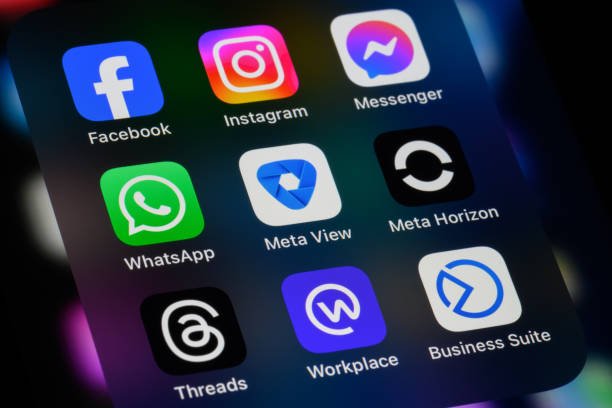
The product ecosystem of Meta is designed to facilitate every form of digital interaction, from public broadcast to private messaging and immersive virtual experiences.
The Social Application Suite
Meta’s social apps are the most widely used in the world, serving as the foundational infrastructure for digital life.
- Facebook: Remains the flagship platform with over 3 billion monthly active users. It has evolved from a social graph into a discovery engine where AI-driven content recommendations (Reels and Video) now dominate the user feed.
- Instagram: The premier platform for visual storytelling and influencer marketing. Instagram has successfully integrated “Reels” to compete with TikTok, with short-form video now accounting for over half of all ads shared on the platform.
- WhatsApp: The world’s leading messaging app with over 2 billion users. In 2026, it is the primary focus for Meta’s “Business Messaging” initiative, featuring integrated payments and AI chatbots for commerce.
- Threads: Launched as a text-based alternative to X (formerly Twitter), Threads has grown rapidly to over 350 million monthly active users, benefiting from deep integration with the Instagram user base. Meta Platforms Superintelligence Infrastructure Strategy 2026
Meta AI: The Universal Assistant
A central product for 2026 is Meta AI, a standalone and integrated assistant that works across all apps. Meta AI is on track to be the most used AI assistant globally, providing real-time information, media generation, and personalized support. The company is testing personalized responses that “remember” user history to provide deeper engagement, such as suggesting products based on previous conversations or interests.
Hardware and Wearables
Reality Labs is shifting its focus from purely virtual reality (VR) to augmented reality (AR) and AI-enabled wearables.
- Ray-Ban Meta Smart Glasses: This is the breakout product of the wearables division, with sales tripling in 2025. The glasses allow users to interact with Meta AI using voice and “look” capabilities—where the AI can see what the user sees and answer questions about the environment.
- Meta Quest Series: The Quest 3S has made mixed reality more affordable, targeting gaming and fitness. While the Quest Pro was discontinued to focus on mass-market adoption, the Quest platform remains the leader in VR hardware with over 70% market share.
- Orion AR Glasses: A prototype representing the next decade of technology. These glasses use in-lens displays to overlay digital information on the physical world, controlled by a neural wristband that translates muscle movements into digital commands.
4. Target Market & Customers
Meta’s target market is virtually the entire global population with internet access. However, the company manages its user base through a highly granular understanding of demographics and regional behaviors.
User Demographics and Behavior
| Platform | Core Demographic | Key Behavior |
| Adults 25–54 | Product discovery and community groups. | |
| Gen Z and Millennials | Visual trends, influencer discovery, shopping. | |
| Global (All Ages) | Direct communication and business interaction. | |
| Threads | Tech/News Enthusiasts | Real-time text-based discussion. |
In the United States, YouTube and Facebook remain the dominant platforms for daily use, but Instagram is the only other app used by at least 50% of adults. Women are more likely to use Instagram (55%) compared to men (44%), while Facebook is the top platform for product discovery, with 39% of consumers using it to find new items.
Regional Market Dynamics
Meta distinguishes between “high-ARPU” (Average Revenue Per User) and “growth” markets. North America and Europe generate the vast majority of revenue despite having a smaller share of the total user base.
- North America/Canada: The average revenue per Facebook user is $68.44. The focus here is on maximizing the efficiency of every ad impression through AI.
- Asia-Pacific/Rest of World: These regions have an average revenue per user of only $5.52. The goal in these markets is to increase user growth and transition users toward business messaging, which has higher monetization potential than traditional display ads in lower-income economies.
The Creator Economy
Creators are a critical customer segment for Meta. The company invested $700 million to attract creators to its platforms, recognizing that high-quality, original content is the primary driver of user engagement. By providing tools like the “Edits” app—which uses generative AI for video production—Meta ensures that its platforms remain the “home base” for the world’s most influential digital voices.
5. Market Position & Competition
In 2026, Meta maintains a dominant position in social media while fighting a multi-front war in the fields of AI, short-form video, and hardware.
The Battle for Short-Form Video: Reels vs. TikTok
Reels has become the primary defense against TikTok’s rapid rise. While TikTok still leads in average time spent per day (61 minutes vs. 49 minutes for Instagram), Meta’s Reels now account for 41% of all time spent on Instagram. Meta’s advantage lies in its “Full-Funnel Ecosystem,” where a user can discover a brand on Reels, engage with it in Stories, and purchase through an integrated shop—a seamless path that TikTok is still working to replicate at scale.
| Metric (2026) | TikTok | Instagram Reels |
| Engagement Rate | 3.73% | 0.48% |
| Daily Active Users | 1.88 Billion | ~2.00 Billion (monthly) |
| Ad Conversion | Lower | 1.3x Higher than TikTok |
| Audience Focus | Gen Z / Gen Alpha | Millennials / Gen X |
Meta as an Infrastructure Competitor
Meta’s competition has shifted from social apps like Snap to hyperscale cloud providers like Microsoft, Amazon, and Google. These four companies are projected to spend a combined $650 billion on AI infrastructure in 2026. Meta’s unique position is that it does not sell cloud services to others; it builds this massive compute capacity solely to improve its own apps and create a proprietary “Personal Superintelligence” for its users.
Open Source vs. Closed Systems
Meta is the world leader in “Open Source AI.” While OpenAI and Google keep their most powerful models behind a paywall or an API, Meta’s release of Llama 4 and 5 has allowed it to capture the developer market. This strategy creates a massive “moat” because thousands of companies are now building their software on Meta’s architecture, making it the de facto standard for the industry.
6. Financial Performance
Meta’s financial story in 2025 and 2026 is one of “unprecedented investment” funded by a “record-breaking ad engine”.
2025 Year-End Results
In 2025, Meta recorded total revenue of $200.97 billion, a 22% increase over 2024. This growth was driven by an 18% increase in ad impressions and a 9% increase in the average price per ad.
| Financial Data (FY 2025) | Amount (USD) | Change (YoY) |
| Total Revenue | $200.97 Billion | +22% |
| Total Costs & Expenses | $117.69 Billion | +24% |
| Income from Operations | $83.28 Billion | +20% |
| Net Income | $60.46 Billion | -3% |
| Diluted EPS | $23.49 | -2% |
The slight dip in net income was caused by a one-time, non-cash income tax charge of nearly $16 billion related to a legislative valuation allowance. Excluding this, Meta’s profitability remained at record highs, with an operating margin of 41%.
The 2026 Capital Expenditure Shock
The most significant financial signal from Meta in early 2026 was the guidance for capital expenditures (CapEx). The company announced plans to spend between $115 billion and $135 billion in 2026, an 87% increase over 2025. This spending is dedicated to “Meta Compute,” the network of data centers and superclusters required to train next-generation AI models. While this spending will compress free cash flow in the short term—potentially dropping it from $52 billion in 2024 to around $10 billion in 2026—analysts project a massive recovery to over $111 billion by 2030 as these investments begin to “yield”.
Cash Position and Dividends
Meta ended 2025 with a “fortress balance sheet” containing $81.59 billion in cash and marketable securities. This liquidity allows the company to fund its AI roadmap while also returning cash to shareholders. In 2025, Meta spent $26.26 billion on share repurchases and initiated a dividend program that paid out $5.32 billion.
7. Funding & Investors
Meta is a publicly traded company on the NASDAQ under the symbol META. It is a favorite among institutional investors due to its strong cash flow and market dominance. Meta Platforms Superintelligence Infrastructure Strategy 2026
Major Shareholders
Institutional ownership of Meta is very high, at approximately 79.79%.
| Institutional Investor | Shares Held | Market Value (Approx.) |
| Vanguard Group Inc. | 199.9 Million | $132.0 Billion |
| BlackRock, Inc. | 171.5 Million | $113.2 Billion |
| FMR LLC (Fidelity) | 130.0 Million | $95.5 Billion |
| State Street Corp | 90.8 Million | $60.0 Billion |
| Geode Capital Management | 52.8 Million | $34.9 Billion |
Hedge fund activity was highly active in the final quarter of 2025, with 2,702 institutional investors adding to their positions while 1,897 decreased theirs. This reflects a “sharp debate” in the investor community: bulls see the $135 billion AI spend as a necessary investment to secure future dominance, while bears worry it might mirror the prior multi-year losses seen in Reality Labs.
Capital Return to Shareholders
Meta has transitioned from a pure growth stock to a “Total Return” stock. In early 2026, the company authorized a $50 billion stock buyback and declared a quarterly dividend of $0.52 per share. Analysts expect the annual dividend to grow from $2.10 per share in 2025 to $3.81 per share by 2030, supported by the projected expansion of free cash flow.
8. Leadership & Management
The leadership of Meta is characterized by a “founder-led” vision that has recently pivoted from social media to infrastructure.
The Executive C-Suite
- Mark Zuckerberg (Founder, Chairman & CEO): Responsible for the overall direction and product strategy. In 2026, he is described by analysts as an “Infrastructure and AI CEO,” focusing on the physical and mathematical backbone of the company rather than just individual app features.
- Dina Powell McCormick (President & Vice Chairman): A key 2026 appointment, McCormick leads the company’s global affairs and strategic partnerships, particularly as Meta navigates complex international energy and regulatory landscapes.
- Javier Olivan (Chief Operating Officer): The operational architect behind Meta’s “Year of Efficiency.” He oversees the business teams and the core infrastructure for the entire Family of Apps.
- Susan Li (Chief Financial Officer): Manages Meta’s massive $120 billion+ budget. She is credited with maintaining fiscal discipline even during periods of extreme capital investment.
- Andrew “Boz” Bosworth (Chief Technology Officer): Leads the Reality Labs team. He is the driving force behind the company’s AR/VR roadmap and the “Ray-Ban Meta” smart glasses success.
- Chris Cox (Chief Product Officer): Leads the development of all Meta apps. He is responsible for the “AI-first” redesign of the Instagram and Facebook feeds.
Management Philosophy and Board Refresh
The board of directors has been refreshed with voices from the semiconductor and energy sectors, such as Hock Tan (CEO of Broadcom) and leaders from the energy industry. This reflects a shift in management philosophy: Meta no longer views itself as a software company but as a “vertically integrated AI titan” that must manage its own supply of chips, data centers, and electricity.
9. Technology & Innovation
Meta’s competitive “moat” in 2026 is built on its leadership in three technological areas: custom silicon, supercomputing clusters, and open-source foundational models.
Silicon Sovereignty: The MTIA Chips
To reduce its multi-billion dollar payments to NVIDIA and improve the efficiency of its AI, Meta has developed its own AI processors called MTIA (Meta Training and Inference Accelerator).
- MTIA v3 “Iris”: Fabricated on TSMC’s cutting-edge 3nm process, the Iris chip is designed specifically for recommendation models. It allows Instagram’s algorithms to process over 1,000 machine learning models per user session without latency.
- Total Cost of Ownership (TCO): By using its own chips for inference (the daily running of the AI), Meta has achieved a 44% reduction in costs compared to using general-purpose GPUs. By the end of 2026, Meta aims to have 35–44% of its total AI workload running on its own silicon.
Supercomputing: Prometheus and Hyperion
Meta is building “Superclusters”—massive networks of computers designed to train the next generation of artificial intelligence.
- Prometheus: A 1-gigawatt (GW) cluster set to go online in 2026. This is the first facility of its size in the world, designed specifically for Meta Superintelligence Labs to train Llama 5.
- Hyperion: A longer-term project that will scale up to 5 GW. Zuckerberg describes these as “titan” clusters that will deliver the most computing power per researcher in the industry.
Open Source AI Strategy
Meta’s decision to make its “Llama” models open-source is a strategic masterpiece. By allowing everyone to use and improve its models for free, Meta has created a “self-reinforcing ecosystem”. This prevents competitors from charging high fees for AI access and ensures that the best developers in the world are working on Meta’s architecture, effectively giving Meta a “free” global R&D team.
10. Marketing & Customer Acquisition
Marketing at Meta has shifted from “buying users” to “monetizing attention” through AI-enhanced precision.
Advantage+ and The Automation of Ads
For Meta’s millions of advertisers, the marketing pitch is simple: “Define your goal, and our AI does the rest”.
- Generative Ad Tools: Meta’s AI can now create text and image combinations from simple prompts, helping small businesses create high-quality ads in seconds.
- Real-Time Personalization: In 2026, ads are generated for each user automatically. If it’s raining where a user is located, the AI might show them an ad for a rain jacket; if it’s sunny, it shows sunglasses—all generated in real-time.
Short-Form Video Hooks
With younger audiences consuming content at three times the speed of older users, Meta has coached advertisers on the “First Seconds Rule”. The AI-driven Reels recommendation system prioritizes ads that capture interest immediately, leading to a 5% boost in conversion rates for advertisers who use Meta’s new AI-driven creative libraries.
Threads and Cross-Platform Integration
Meta acquires and retains customers by leveraging its “cross-product integration”. Threads reached 350 million users largely because Meta allowed Instagram users to sign up with one tap. This “network effect” ensures that even when Meta launches a new product, it can reach hundreds of millions of people instantly, a marketing power that no other company possesses.
11. Operations & Supply Chain
Meta’s operations have expanded from managing server farms to securing the basic building blocks of modern civilization: fiber and power.
The $6 Billion Corning Agreement
In early 2026, Meta signed a multi-year agreement with Corning worth up to $6 billion to secure the supply of optical fiber and cable for its U.S. data centers. This agreement is critical because high-performance AI superclusters require massive amounts of “optical connectivity” to transfer data between thousands of GPUs in near real-time. By partnering with Corning, Meta is strengthening its domestic supply chain and ensuring it has the “plumbing” necessary for its AI future.
Data Center Network
Meta has 26 data centers either operational or under construction in the United States. These facilities are massive industrial projects that have supported over 30,000 construction jobs and require 5,000 full-time staff to operate, including electricians, HVAC specialists, and server technicians.
IT Hardware Retirement Wave
Meta’s aggressive upgrade to AI-specific hardware has created a “retirement wave” for older servers. The company is now partnering with recycling and IT asset disposition (ITAD) providers to harvest high-value components from retired hardware, reflecting a more mature and circular operational approach.
12. Customer Experience & Loyalty
Meta measures customer loyalty through “engagement”—how much time and how often people use its apps. In 2026, the customer experience is being redefined by AI-driven personalization and proactive safety.
Personalization and AI Agents
The goal of “Personal Superintelligence” is to make the apps feel indispensable. Early testing of personalized AI responses on Meta AI has shown that users are more likely to return to the app if the AI remembers their previous preferences or questions. For instance, an AI agent on WhatsApp might remember a user’s dietary restrictions when helping them book a restaurant, creating a level of convenience that drives long-term loyalty.
Trust and Safety Initiatives
Customer loyalty is fragile, especially concerning youth safety. Meta has introduced “Teen Accounts” and expanded parental controls to address growing concerns about social media’s impact on minors. While these protections were implemented knowing they might cut teen traffic by 3.3%, Meta views this as a necessary trade-off to maintain long-term trust with parents and regulators.
Click-to-Message and Direct Support
Loyalty is also being built through “Social Customer Service.” 45% of consumers now use Meta’s platforms to seek support from brands. By making it easy for a user to click an ad and start a WhatsApp conversation with a company, Meta has turned its messaging apps into a critical bridge for customer-brand loyalty.
13. Company Culture & Workforce
After the “Year of Efficiency,” Meta’s culture has shifted from the famous “Move Fast and Break Things” to a strategy of “Scale Fast and Build Moats”.
Workforce Statistics and Trends
Meta ended 2025 with 78,865 employees, a 6% increase year-over-year as it began hiring again for AI and infrastructure roles.
| Workforce Metric (2025-26) | Value |
| Total Headcount | 78,865 |
| Reality Labs Layoffs (2026) | ~1,000 (10% of division) |
| Core Growth Driver | AI and Technical Talent |
| Employee Engagement (Industry) | 64% (down from 88%) |
In early 2026, Meta conducted a restructuring of its Reality Labs division, cutting 1,000 jobs and shutting down three in-house VR game studios. This reflects a cultural shift toward “engineering-driven rigor,” where divisions that do not align with the immediate AI hardware goals are streamlined. Meta Platforms Superintelligence Infrastructure Strategy 2026
Diversity and Engagement
The company continues to prioritize Diversity, Equity, and Inclusion (DEI) through its Accessibility & Engagement programs led by Maxine Williams. However, like much of the tech industry, Meta is navigating a “fragmented” return-to-office landscape. While remote work has shown benefits in reducing burnout (61% of remote workers report less burnout), Meta’s management has increasingly emphasized in-person work to foster the spontaneous innovation required for complex AI engineering.
14. Risks & Challenges
Despite its strengths, Meta faces significant “execution risks” and external threats that could impact its future growth.
The ROI of AI Spending
The primary financial risk is whether the $115–135 billion capital expenditure plan will generate a high enough Return on Invested Capital (ROIC). If the AI-driven improvements in advertising and the new revenue from WhatsApp do not grow fast enough to cover the massive depreciation and operating costs of the data centers, Meta could see its profit margins compress significantly.
Regulatory and Antitrust Fire
Meta is caught in a “looming antitrust crisis” in Europe. The European Commission has charged Meta with an antitrust breach over “WhatsApp AI Exclusivity,” which could force the company to open its messaging API to rivals, potentially destroying its “personalization” moat.
Compute Capacity Constraints
Despite its spending, Meta remains “capacity-constrained”. The company cannot build data centers and get electricity fast enough to train the increasingly complex AI models it envisions. This creates a risk that competitors who manage their infrastructure more efficiently could leapfrog Meta in the race for Artificial General Intelligence (AGI).
15. Legal & Compliance
In 2026, Meta is facing “landmark trials” that could fundamentally change the legal protections for social media companies.
The Youth Safety Trials
- New Mexico Attorney General Case: Meta is on trial in Santa Fe, accused of knowingly enabling predators to exploit children on Facebook and Instagram.
- Social Media Addiction Lawsuits: A major case in Los Angeles involves 1,600 plaintiffs (families and schools) who allege that Meta and YouTube deliberately designed addictive features that caused mental health issues in children.
The Threat to Section 230
These lawsuits are significant because they are focus on “platform product design” rather than the content itself. If judges rule against Meta, it could weaken “Section 230,” the U.S. law that protects websites from being sued for what their users post. This would open the “dam” for thousands of new lawsuits, creating a permanent legal tax on Meta’s business.
EU Privacy Rulings
Meta is also monitoring legal headwinds in the EU regarding its “Less Personalized Ads” offering. If European regulators find that Meta is not providing a fair choice to users, it could significantly impact its ability to target ads in one of its most lucrative markets.
16. Sustainability & ESG
Meta’s sustainability strategy has evolved from simple carbon credits to fundamental energy innovation.
The Nuclear Energy Pivot
To meet the 24/7 power demands of its AI data centers without increasing its carbon footprint, Meta has become one of the largest corporate purchasers of nuclear power in history.
| Energy Partner | Capacity | Goal |
| Vistra | 2.1 GW | Immediate carbon-free power for the grid. |
| Oklo | 1.2 GW | Advanced “small modular reactors” for Ohio data centers. |
| TerraPower | 2.8 GW | Funding next-gen “Natrium” reactors for the 2030s. |
By securing 6.6 gigawatts of clean capacity by 2035, Meta is ensuring its “Sustainable AI” thrive without eclipsing its climate goals.
Net Zero and Water Goals
Meta has maintained net-zero emissions in its global operations since 2020 by matching 100% of its electricity use with renewable energy. The company is also on track to be “Water Positive” by 2030, meaning it will restore more water than it consumes in high-stress regions. In 2024 alone, it restored 1.5 billion gallons of water through habitat restoration and water quality projects.
17. Growth Strategy & Future Plans
Meta’s growth strategy is built on a “Yield Cycle”—a multi-year plan to build infrastructure today that will generate massive profits tomorrow.
The Three Pillars of Future Growth
- AI-Driven Advertising: By automating the entire ad process, Meta expects to capture a larger share of global GDP as businesses of all sizes find it easier and more profitable to advertise on its platforms.
- WhatsApp as a Commercial Engine: Turning WhatsApp from a free messaging app into a global commerce platform where businesses pay for every interaction is Meta’s “next pillar” of revenue.
- The Wearables Transition: Meta plans to launch its first commercial AR glasses in late 2026, aiming to establish a new computing platform that it owns and controls, freeing it from the rules of Apple and Google.
Long-Term Financial Outlook
Analysts forecast that despite the massive spending in 2026, Meta’s revenue will continue to grow as its AI-led products mature. By 2030, revenue is projected to hit $274 billion, with free cash flow expanding to $111 billion, allowing for consistent dividend hikes and shareholder returns.
18. SWOT Analysis
Strengths
- Unmatched Scale: Over 3.5 billion people use Meta apps daily, creating a powerful network effect.
- Data Advantage: The sheer volume of user data allows Meta’s AI to be more personalized and effective than rivals.
- Financial Fortress: $81 billion in cash provides the “war chest” needed for the AI arms race.
- Open Source Leadership: Llama models make Meta the industry standard for AI developers.
Weaknesses
- Heavy Capex Burden: $135 billion in spending creates short-term pressure on cash flow.
- Reality Labs Losses: $19 billion annual loss is still a major drag on the bottom line.
- Regulatory Scrutiny: Frequent lawsuits and antitrust investigations create ongoing legal risks.
Opportunities
- WhatsApp Monetization: Significant untapped revenue potential in business messaging.
- AI Wearables: Smart glasses could replace smartphones as the primary way people interact with AI.
- Emerging Markets: Growing internet penetration in Asia and Africa provides a massive new user base.
Threats
- TikTok Competition: Continues to lead in total time spent by younger demographics.
- Compute Costs: The rising cost of chips and energy could make AI development too expensive even for a giant like Meta.
- Privacy Rulings: Adverse court decisions could destroy the company’s ability to target ads effectively.
19. Industry & Market Trends
The global advertising market is undergoing a “Social Search” revolution. In 2026, social platforms like Instagram and TikTok drive over 60% of product discovery, while traditional Google search share is declining. Another critical trend is the “Energy-Compute Nexus”—the realization that AI leadership is as much about securing power as it is about software. Meta’s focus on nuclear energy and custom silicon puts it at the forefront of this trend.
20. Final Evaluation
Meta Platforms has entered a period of “High-Risk, High-Reward” industrialization. By successfully navigating the “Year of Efficiency” in 2023, the company proved it could be disciplined. In 2026, it is using that discipline to fund a $135 billion bet on the future. While Reality Labs remains a loss-making segment, the early success of AI-powered smart glasses and the rapid growth of Reels suggest that Meta’s vision of a post-smartphone, AI-driven world is becoming a reality. The company’s core advertising engine remains incredibly profitable, providing the “cushion” needed to fund its transition into an infrastructure titan. However, the outcome of landmark youth safety trials and the ROI on its massive AI data centers will be the ultimate deciders of whether Meta remains a dominant leader or becomes a victim of its own ambition. Meta Platforms Superintelligence Infrastructure Strategy 2026
FAQ
Why is Meta spending $135 billion in 2026? This money is for “Meta Compute”—building the data centers, buying the chips, and securing the energy needed to run the next generation of artificial intelligence.
How does Meta make money if Facebook and Instagram are free? Meta makes 97% of its money by selling ads. It uses AI to show users ads that they are more likely to be interested in, which makes the ads more valuable to businesses.
Is Meta still working on the Metaverse? Yes, but the focus has shifted toward “AI Wearables” like smart glasses. Meta believes that AI and the Metaverse will come together through glasses that let you see digital things in the real world.
What is the MTIA chip? MTIA is a custom computer chip designed by Meta to run its AI more cheaply and faster than the general-purpose chips it buys from other companies.
What are the main legal problems Meta has right now? Meta is facing major trials where it is accused of making its apps addictive to children and not doing enough to protect young people from online predators.