Table of Contents
Global Startup Funding Hits a Record High: The New Era of Venture Capital.
Executive Summary
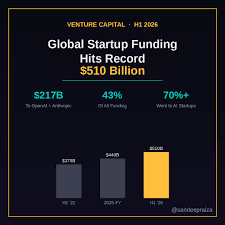
The first half of 2026 represents a historic inflection point in the trajectory of global private capital markets. Following a prolonged period of macroeconomic contraction, valuation resets, and frozen liquidity that characterized the 2022–2024 venture landscape, the industry has not merely rebounded but aggressively accelerated into a new paradigm. Global startup funding reached an unprecedented $510 billion in the first half (H1) of 2026, setting a new absolute record for any half-year period and entirely eclipsing the $440 billion deployed across the entirety of 2025.
However, beneath these headline figures lies a radically transformed market architecture defined by extreme capital concentration and sector monopolization. The current venture ecosystem is fundamentally governed by an arms race in frontier artificial intelligence and the computational infrastructure required to sustain it. In a staggering display of market polarization, just two entities—OpenAI and Anthropic—absorbed $217 billion, representing 43% of all global venture capital deployed worldwide in H1 2026. This hyper-concentration has engineered a structural “barbell dynamic,” wherein capital flows abundantly into early-stage seed vehicles and late-stage AI mega-rounds, while severely compressing the middle-market Series B and C stages for non-AI enterprises.
Simultaneously, the geopolitical landscape of venture capital has undergone a profound shift. Sovereign wealth funds (SWFs), primarily emanating from the Middle East and Asia, have emerged as the dominant financiers of global compute infrastructure, deploying hundreds of billions of dollars directly into startups to secure national technological autonomy and circumvent traditional venture fund structures. Furthermore, the long-dormant exit window violently reopened in the second quarter of 2026. The period witnessed historic liquidity events, headlined by SpaceX’s $75 billion initial public offering (IPO) at a $1.77 trillion valuation, followed immediately by its $60 billion all-stock acquisition of AI coding platform Cursor.
This comprehensive report examines the macroeconomic drivers, sector-specific capital flows, regional ecosystem transformations, regulatory headwinds, and the structural return of liquidity defining the record-breaking 2026 global startup funding environment.
The Macroeconomic Trajectory: From Stabilization to the 2026 Supercycle
To fully contextualize the sheer magnitude of the 2026 venture funding surge, it is necessary to examine the severe volatility of the preceding years. The global venture market underwent a drastic contraction beginning in late 2022 and enduring through 2024, driven by persistent inflationary pressures, elevated central bank interest rates, and a closed exit window that left limited partners (LPs) starved for distributions and inherently cautious.
The 2025 Market Stabilization and Incubation
The year 2025 served as a transitional period of stabilization, establishing the baseline for the subsequent supercycle. Global venture and growth investors deployed $425 billion across more than 24,000 private companies, representing a 30% year-over-year recovery from the $328 billion deployed in the 2024 trough. (Alternative data providers, such as KPMG and the Bundesverband Deutscher Kapitalbeteiligungsgesellschaften, tracked 2025 global deployment as high as $469 billion to $512 billion, reflecting varying methodologies regarding corporate venture capital and private equity growth rounds).
While 2025 established itself as a top-three historical year by capital volume, the recovery was highly asymmetric. The global deal count actually continued to fall, dropping roughly 17% year-over-year to around 29,500 transactions, marking the third consecutive year of declining deal volume. Capital was increasingly allocated to highly capitalized incumbents, evidenced by the fact that mega-rounds ($100 million or more) accounted for up to 66% of total capital deployed, while the AI sector alone commanded $211 billion to $226 billion.
The H1 2026 Explosion and the Path to One Trillion
The momentum building in late 2025 erupted in the first quarter of 2026. The Q1 2026 period saw investors pour $305 billion into global startups, an all-time high for any single quarter, representing nearly 70% of the entire 2025 funding total. This historic surge was immediately followed by a Q2 2026 total of $205 billion across more than 5,000 startups, establishing it as the second-largest quarter on record. Based on the $510 billion deployed in the first six months, leading market intelligence firms project that full-year 2026 venture funding is on track to eclipse $1.0 trillion, representing a potential 127% increase versus 2025.
| Funding Period | Total Global Funding | Key Market Characteristics |
| Full Year 2024 | $328 Billion | Market trough; severe liquidity constraints, valuation resets, and LP hesitancy. |
| Full Year 2025 | $425 Billion – $512 Billion | 30%+ YoY growth; early AI concentration; declining overall deal volume. |
| Q1 2026 | $305 Billion | All-time quarterly record; driven largely by OpenAI’s historic $122B raise. |
| Q2 2026 | $205 Billion | Second-highest quarter on record; driven heavily by Anthropic’s $65B raise. |
| H1 2026 Total | $510 Billion | New absolute half-year record; surpasses all of 2025 combined. |
| 2026 Projection | $1.0 Trillion | Annualized projection indicating a systemic paradigm shift in private capital. |
The Structural “Barbell Dynamic”
The influx of capital in 2026 masks a severe bifurcation in the asset class, structurally identified as the “barbell dynamic.” On one end of the barbell, mega-rounds command the vast majority of deployed capital. Late-stage venture funding totaled $134 billion in Q2 2026 alone, up 141% from the prior year. On the opposite end, seed-stage deal counts have recovered to 2021 levels, as early-stage investors aggressively search for the next generation of AI-native applications, biotech innovators, and defense tech platforms. Global seed funding reached $12 billion in Q2 2026, though even this is polarized: $2.8 billion went to mega-seed rounds of $100 million or more, leaving a highly competitive environment for traditional seed rounds under $10 million.
The structural consequence of this barbell effect is the severe compression of the middle market (Series B and C). Growth investors are facing an environment where capital is remarkably scarce for companies lacking the hyper-growth metrics of AI-native peers. For founders operating outside the frontier-lab tier, the fundraising environment remains arguably as challenging as it was in 2023, requiring rigorous discipline regarding unit economics, default-alive operational metrics, and immediate paths to profitability rather than speculative growth.
The Artificial Intelligence Singularity: Unprecedented Capital Concentration
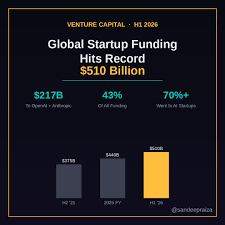
The defining characteristic of the 2026 venture supercycle is the absolute monopolization of capital by a singular sector: Artificial Intelligence. In Q2 2026, more than 70% of all global startup capital was directed toward AI-focused companies, up from roughly 50% in 2025. The remaining 30% of the global venture market—encompassing fintech, consumer tech, digital health, and traditional enterprise SaaS—is left to compete for a significantly diminished share of the aggregate capital pool.
The Frontier Lab Duopoly: OpenAI and Anthropic
The scale of capital absorption by the leading frontier AI labs is reshaping the mechanics of global finance, transforming venture capital from a highly distributed asset class into an infrastructure financing mechanism. In H1 2026, OpenAI and Anthropic collectively raised $217 billion, accounting for 43% of every startup dollar raised worldwide.
The catalyst for the Q1 2026 surge was OpenAI’s historic $122 billion funding round. This single transaction comprised 43% of the global quarterly deal value, functionally acting as a macroeconomic market-maker rather than a standard venture financing event. By Q2 2026, Anthropic responded by closing a $65 billion Series H financing round, elevating its post-money valuation to $965 billion. This round, led by Altimeter Capital, Dragoneer, Greenoaks, and Sequoia Capital, alongside strategic co-leads Coatue and ICONIQ, allowed Anthropic to temporarily surpass OpenAI’s $852 billion valuation. The financing also included $15 billion in previously committed investments from hyperscalers, heavily tethering Anthropic to massive cloud infrastructure pipelines provided by Amazon and Google.
The financial metrics supporting these near-trillion-dollar valuations reflect a fundamental shift in market perception. By May 2026, Anthropic reported an annualized revenue run-rate exceeding $47 billion, while projecting Q2 2026 revenues of $10.9 billion—a 130% increase from the prior quarter. These revenue multiples (roughly 20.5x for Anthropic based on its run-rate) indicate that investors are pricing these entities not as speculative software companies, but as foundational utility providers for the 21st-century digital economy, akin to telecommunications networks or energy grids.
Beyond the Duopoly: The Global LLM and Compute Race
While OpenAI and Anthropic dominate the headline figures, the frontier AI race involves several other massively capitalized entities. Elon Musk’s xAI secured a $20 billion round in Q1 2026, pushing its total funding to over $37.1 billion. Autonomous driving pioneer Waymo captured $16 billion in Q1, while physical AI startup Prometheus raised $12 billion in Q2.
Beneath the model layer, a secondary tier of capital concentration is occurring at the infrastructure level. The physical limitations of global compute capacity have driven massive investments into AI data center developers, specialized silicon designers, and energy infrastructure. Singapore-based DayOne raised $2.5 billion in Q2 2026 to scale data centers running on 100% renewable energy. In India, Yotta Data Services secured a $150 million bet on sovereign AI compute, targeting the deployment of 85,000 NVIDIA Blackwell GPUs at a $4.4 billion valuation. Companies like CoreWeave, Crusoe, and Lambda continue to command significant growth capital as the AI hardware sector effectively behaves as a capital-intensive industrial play.
Sectoral Case Studies: Innovation and Capital Flows Beyond Foundation Models
While foundation models consumed the vast majority of media attention and capital volume, profound structural shifts occurred across specialized verticals in H1 2026. Industries that successfully combined AI software with physical technology or automated highly complex, regulated workflows saw record-high funding levels.
Defense Technology: The Geopolitical Imperative
Defense tech funding hit an all-time absolute record in 2026. Within the first five months of the year, startups in military, national security, and law enforcement categories raised over $14.6 billion, easily eclipsing the previous full-year record of $9.6 billion set in 2025. This surge is predicated on global geopolitical instability and the realization that software-defined warfare, autonomous systems, and AI-driven battlefield decision-making are rapidly outpacing traditional hardware procurement cycles.
Southern California-based Anduril Industries led the sector with a $5 billion Series H at a $30.5 billion valuation, cementing its status as the world’s most valuable venture-backed defense startup. Other significant rounds demonstrated the breadth of the sector’s expansion:
- Saronic: An Austin-based developer of autonomous sea vessels raised a $1.75 billion Series D led by Kleiner Perkins, valuing the company at $9.25 billion.
- Shield AI: The autonomous aviation startup secured a $2 billion Series G led by Advent International and JPMorgan Chase.
- Helsing: The Munich-based defense AI firm closed a $1.8 billion Series E at an $18 billion valuation, marking Europe’s largest-ever defense-tech round.
- Mach Industries: An autonomous drone systems manufacturer that raised a $300 million Series C at a $1.8 billion valuation.
Robotics and Embodied AI: The Hardware Renaissance
Robotics funding has fundamentally detached from its historical reputation as an asset-heavy, low-margin, and highly speculative hardware gamble. Investors are aggressively funding “embodied AI”—artificial intelligence integrated into physical systems capable of real-time environmental interaction and autonomous learning. Globally, robotics startups raised $18.8 billion in the first half of 2026, easily surpassing the $15 billion raised in all of 2025 and the $14.1 billion peak of 2021. Global Startup Funding Hits a Record High: The New Era of Venture Capital
Standout rounds included Skild AI’s $1.4 billion raise, led by SoftBank Group, to build an “omni-bodied” foundational brain capable of operating any robot for any task, which tripled its valuation to over $14 billion. In Europe, Germany’s Neura Robotics secured up to $1.4 billion in Series C funding to develop AI infrastructure for collaborative real-world robot operation. In China, the sector saw robust liquidity, with the highly anticipated public listing of Unitree Robotics targeting a multi-billion dollar valuation, and industrial robot manufacturer Robotphoenix raising $86 million on the HKEX.
Legal Technology: Automating the Knowledge Worker
Venture funding for legal tech startups reached a record high as investors capitalized on generative AI’s potential to automate complex contractual, compliance, and research workflows within the legal profession. Following a record $4.08 billion raised in 2025 (a 77.4% increase from 2024), the momentum accelerated into 2026.
Swedish legal tech startup Legora secured a $50 million Series D extension from Nvidia’s NVentures, bringing its round total to $600 million and its valuation to $5.5 billion—a massive jump from its $1.8 billion valuation just eight months prior. Other major players executing massive raises included Harvey, a San Francisco-based provider of AI tools for lawyers, which raised over $1 billion across multiple rounds, and Filevine, which secured $400 million in practice management funding. Toronto-based Blue J and Palo Alto’s Eudia also secured nine-figure rounds, illustrating a global consensus on the modernization of the legal sector.
Fintech: The “Lab-i-fication” of Financial Infrastructure
Following a sharp cooldown in 2023, fintech funding rebounded carefully but decisively. In H1 2026, global fintech startups raised $28.6 billion, a 22.7% year-over-year increase. Intriguingly, this increase in dollar volume occurred alongside a 25.7% decline in deal count, indicating that investors are writing fewer but substantially larger checks for proven, default-alive category leaders.
The sector is undergoing a structural evolution described by analysts as the “lab-i-fication” of the modern corporation. Highly profitable, scaled fintech platforms are utilizing their massive data advantages to fund experimental AI divisions. Expense management startup Ramp, for example, raised $750 million at a $44 billion valuation in mid-2026 to compete directly with AI research labs for elite engineering talent. Meanwhile, payments infrastructure giant Stripe executed tender offers providing liquidity at a $159 billion valuation. The core focus of fintech investment has shifted definitively away from consumer neobanks toward AI-enabled fraud detection, embedded finance, wealth management, and enterprise billing infrastructure. Furthermore, emerging market super-apps are capturing massive scale, highlighted by Uzbekistan’s Uzum raising over $130 million to expand its digital banking and e-commerce ecosystem.
Cybersecurity: The AI Defense Layer
As AI agents proliferate across enterprise networks, the necessity for sophisticated security protocols to monitor their activities has driven robust funding. Privacy and cybersecurity startups pulled in $10.6 billion in financing across stages in H1 2026. While Q2 2026 saw a slight 30% sequential decline, the quarter still produced eight rounds of $100 million or more.
The largest Q2 funding recipient was Cyera, a developer of AI-enabled enterprise security tools, which raised $600 million at a $12 billion valuation. NinjaOne, an endpoint management platform, raised over $400 million at a $12.3 billion valuation, while Israeli startup Dream secured $260 million for government cyber defense. Consolidation is also active in the space, highlighted by Motorola Solutions’ $1.5 billion acquisition of Israeli counter-drone technology company D-Fend Solutions.
Climate Tech and Energy Infrastructure: Powering the AI Boom
Venture capital investment in climate technology reached $26.1 billion in H1 2026, up 55% over the same period in 2025, marking the strongest fundraising half for the sector since 2022. However, the narrative has shifted drastically away from traditional ESG metrics toward acute infrastructure necessities. The primary driver of climate tech funding in 2026 is the voracious, unprecedented energy demand of AI data centers.
Data center-related energy technologies accounted for 34% of all climate funding in H1 2026, up from just 3% a year prior. Because traditional gas turbine wait times have become heavily stretched due to supply chain bottlenecks, tech giants are investing aggressively in clean firm generation to win the “speed-to-power race”. This dynamic fueled a record quarter for cleantech IPOs and mega-rounds, including advanced geothermal developer Fervo’s $1.9 billion IPO, modular nuclear reactor developer X-Energy’s $1 billion IPO, and Proxima Fusion’s $470 million infrastructure round.
The Sovereign Wealth Fund Era: Geopolitics as an Asset Class
A fundamental shift in the 2025-2026 venture capital landscape is the aggressive entry of sovereign wealth funds (SWFs) as direct, lead investors in frontier technologies. Sovereign entities, which now collectively manage over $16.3 trillion globally, are no longer functioning merely as passive limited partners allocating to traditional venture capital funds. Instead, they are deploying capital directly to secure national strategic autonomy over AI compute, data infrastructure, and advanced manufacturing, fundamentally altering the competitive dynamics of private equity.
Since 2025, governments and state-owned investors have committed more than $350 billion to AI infrastructure globally, with $120 billion committed specifically for physical assets like data centers and semiconductors. This reallocation of capital is driven by a dual mandate: generating long-term financial returns while executing national developmental objectives and insulating domestic economies from external supply chain shocks.
Middle Eastern Capital Dominance
The locus of sovereign AI investment is heavily concentrated in the Gulf states, which are aggressively utilizing massive hydrocarbon revenues to pivot their economies toward artificial intelligence and deep tech infrastructure.
- MGX (United Arab Emirates): Backed by Abu Dhabi’s Mubadala and G42, MGX was founded in 2024 and swiftly closed a $49 billion flagship AI fund in July 2026, bypassing its $45 billion target. MGX has become a primary kingmaker in the AI arms race, co-leading OpenAI’s $122 billion round and Anthropic’s $65 billion Series H, while also establishing a $40 billion joint venture (AIP) with Temasek and Kuwait to acquire assets like Aligned Data Centers. The fund’s objective is to scale past $100 billion in assets under management (AUM) while deploying up to $10 billion annually.
- PIF and HUMAIN (Saudi Arabia): Saudi Arabia’s Public Investment Fund (PIF), which operates as a dual-mandate fund driving the Kingdom’s economic diversification, deployed an extraordinary $36.2 billion into AI-related transactions in 2025 alone through its dedicated AI subsidiary, HUMAIN. Strategic moves included a $3 billion stake in xAI’s Series E, a $10 billion joint venture with AMD to build 500 megawatts of data center capacity, and the launch of a dedicated $10 billion venture capital fund in 2026.
The Global Sovereign Response
Western and Asian governments are reacting to the sheer volume of Middle Eastern and private US capital by launching their own sovereign AI initiatives to prevent technological colonization and ensure sovereign data control.
- United Kingdom: In April 2026, the UK launched a £500 million ($630 million) Sovereign AI Fund designed to take direct equity stakes in early- and growth-stage British AI startups. This is augmented by a £282 million Strategic Assets Grants Programme and £750 million dedicated to a national AI supercomputer. Global Startup Funding Hits a Record High: The New Era of Venture Capital
- France (France 2030): Operating under a €109 billion macro-commitment, France aims to deploy 1.2 million GPUs and train 100,000 AI professionals annually by 2030, anchored by facilities like the Jules Verne AI Factory.
- Japan: The Ministry of Economy, Trade and Industry (METI) has committed ¥1 trillion ($6.2 billion) over five years to the Noetra public-private consortium, backing 44 companies in a concerted physical AI and robotics push.
- Established Global SWFs: Massive established funds like Norway’s Norges Bank Investment Management ($1.8 trillion AUM) and the China Investment Corporation ($1.57 trillion AUM) are increasingly active in direct co-investments and real asset allocations, providing unprecedented liquidity pools outside the traditional venture ecosystem.
| Sovereign Fund / Initiative | Country | Capital Commitment / Scale | Key 2025/2026 Strategic Moves |
| MGX | UAE | $49B Flagship Fund | Co-led Anthropic $65B and OpenAI $122B rounds; $40B AIP infrastructure JV. |
| HUMAIN (PIF) | Saudi Arabia | $36.2B deployed (2025) | $10B AMD JV; $3B xAI stake; launching $10B VC fund. |
| Sovereign AI Fund | United Kingdom | £500M ($630M) | Direct equity investments in British AI startups; national supercomputer. |
| France 2030 | France | €109B (Total Plan) | Jules Verne AI Factory; 1.2M GPU deployment target. |
| Noetra Consortium | Japan | ¥1 Trillion ($6.2B) | Physical AI and robotics push involving 44 domestic companies. |
The second-order implication of SWF dominance is the crowding out of traditional venture capital. Because sovereign funds operate with near-infinite time horizons and are untethered from the traditional 10-year closed-end fund lifecycle, they can outbid tier-one Silicon Valley venture firms for access to the most capital-intensive foundational models, fundamentally altering the governance and capitalization tables of private markets.
Geographic Realignment: The Shifting Centers of Global Innovation
While the United States continues to anchor the global venture ecosystem, H1 2026 highlighted significant regional realignments. Capital is migrating to ecosystems capable of supporting either advanced sovereign AI infrastructure or massive consumer scaling, while historically dominant hubs face increased competition.
North America: The Undisputed Heavyweight
In the first half of 2026, North American startup funding shattered records, primarily driven by US-based AI megadeals. H1 2026 investment for US and Canadian startups reached a staggering $392 billion. In Q1 2026, US-based companies captured 83% of the global venture capital total ($250 billion), a figure heavily skewed by the massive OpenAI transaction. By Q2 2026, the US share normalized slightly to 66% (two-thirds) of global startup capital, aligning with historical averages, while eight of the sixteen billion-dollar rounds globally in Q2 were minted on American soil.
The San Francisco Bay Area remains the global epicenter, generating $390.3 billion in venture capital over the trailing twelve months to Q2 2026, dwarfing all other regions. However, New York has firmly established itself as a powerful secondary node, particularly dominating in fintech, enterprise software, and AI-enabled financial services, generating nearly $43 billion in TTM funding.
Asia: The Resurgence of China and Maturation of India
The Asian venture market experienced a massive influx of capital in Q2 2026, pulling in $42.8 billion—the highest quarterly total in over three years.
- China’s LLM Push: Chinese companies absorbed $30 billion in Q2 2026, a staggering 424% year-over-year increase. This surge was entirely dictated by China’s aggressive development of domestic foundational models to counter Western technological hegemony. DeepSeek was the largest fundraiser of the quarter in Asia, securing $7.4 billion at a reported $50 billion valuation. StepFun and Moonshot AI (developer of the Kimi K3 open-source model) also raised massive capital to compete directly with Anthropic’s Claude and OpenAI’s GPT models.
- India’s Deep Tech Maturation: India cemented its status as a vital global hub, generating between $6.9 billion and $7.4 billion in startup funding during H1 2026 (the variance reflects data reporting lags and undisclosed rounds). This represented a 21% year-over-year increase. The narrative of Indian venture capital is fundamentally shifting away from consumer internet toward deep tech and AI infrastructure. Artificial intelligence became the top investment theme, capturing 28% of all deals ($2.07 billion), led by AI infrastructure firm Neysa ($1.2 billion) and sovereign AI startup Sarvam ($234 million). Additionally, India is witnessing a geographic decentralization of capital; while Bengaluru ($3.8 billion), Mumbai ($1.96 billion), and Delhi-NCR continue to dominate, Tier-2 cities such as Hyderabad, Pune, Chennai, and Ahmedabad accounted for over 35% of total deal volume in Q1 2026.
- Singapore & Southeast Asia: Benefiting from its position as a neutral financial hub, Singapore attracted $3.6 billion in Q2 2026, anchored by sovereign-backed entities and strategic AI infrastructure investments like DayOne’s $2.5 billion round. The broader Southeast Asian venture ecosystem saw funding rise 115.8% YoY to $7.65 billion.
Europe: Regulatory Complexity vs. Deep Tech Prowess
Europe posted its strongest venture funding quarter in four years during Q2 2026, raising $24 billion, which pushed the H1 2026 total to $42 billion (a 50% year-over-year increase). Despite the heavy regulatory burden imposed by the EU AI Act, European deep tech and AI labs are successfully attracting vast amounts of capital.
The United Kingdom significantly widened its lead as Europe’s primary hub, capturing $10.4 billion in Q2 2026—its third-largest funding quarter on record. The UK ecosystem is demonstrating particular strength in biotech, quantum computing, and AI, highlighted by mega-rounds for Isomorphic Labs, Ineffable Intelligence ($1 billion seed round), and Oxford Quantum Circuits. Germany followed with $3.2 billion, driven by industrial robotics and defense tech (e.g., Neura Robotics, Helsing, Isar Aerospace), while France secured $2.4 billion and Sweden secured $2 billion.
Africa: Stability and the Shift to Hard Assets
The African venture ecosystem exhibited remarkable stability amidst global volatility, raising between $1.3 billion and $1.4 billion in H1 2026, largely in line with 2025 figures. However, the funding mix demonstrated a clear pivot toward hard assets and infrastructure. Investors backed larger, established companies with proven business models in electric mobility, clean energy, and financial infrastructure. The largest deal came from electric mobility company Spiro, which raised $270 million through two equity rounds, highlighting a preference for climate-aligned industrial growth over early-stage software.
The Return of Liquidity and the “Agentic Discount”
The most consequential structural shift in the 2026 venture ecosystem occurred on the exit side of the ledger. Between 2022 and 2024, the IPO and M&A markets were virtually frozen, resulting in nearly $200 billion in negative net cash flows to limited partners and creating a massive backlog of unexited unicorns valued at over $4.3 trillion.
In Q2 2026, the exit window violently reopened. The quarter produced the highest exit values on record for venture-backed companies, with 32 companies going public at valuations above $1 billion, and another 24 acquired at or above that mark, yielding a combined $113 billion in M&A deal value. This sudden return of liquidity is paramount; it allows venture funds to distribute capital back to LPs, thereby rebooting the capital recycling engine necessary to sustain ongoing early-stage funding.
The SpaceX Phenomenon and the “Agentic Discount”
The defining transaction of the 2026 cycle was the public listing of SpaceX. The aerospace and satellite conglomerate went public at a staggering $1.77 trillion valuation, raising $75 billion in the largest venture-backed listing in history.
However, the ripple effects of the IPO were magnified days later when SpaceX executed a $60 billion all-stock acquisition of Anysphere, the startup behind the AI coding agent Cursor. This transaction represents the largest startup acquisition on record and signifies a profound shift in corporate M&A philosophy.
Market analysts have termed this new paradigm the “Agentic Discount.”. Historically, enterprise software valuations were predicated on seat-based licensing tied directly to human headcount. The SpaceX-Cursor acquisition demonstrates that acquirers are now willing to pay massive premiums for AI and agentic output that scales exponentially through compute, while aggressively penalizing (discounting) startups that rely on traditional human-capital scaling. Cursor’s product effectively replaces engineering headcount with software—representing the marginal cost of expertise repricing in real-time. Traditional B2B SaaS startups that fail to transition to an agentic, outcome-based pricing model face severe valuation compression in this new exit environment.
The Hardware IPOs: Cerebras Systems and Quantinuum
The public markets also demonstrated a voracious appetite for AI hardware and quantum computing, though post-IPO performance proved highly volatile, illustrating the market’s demand for rigorous fundamentals.
In May 2026, AI chipmaker Cerebras Systems raised $5.55 billion in the largest US technology IPO since Uber, pricing its 30 million shares at $185. The stock initially surged 68% to touch $386, valuing the company near $85 billion, driven by the narrative of its Wafer-Scale Engine outperforming Nvidia in certain AI inference workloads. However, intense market scrutiny regarding the company’s deeply negative operating margins (projected negative 28% to 32% for the full year despite beating Q1 revenue estimates of $180.8M by posting $193.4M) and severe customer concentration (with 86% of 2025 revenue tied to two UAE-linked entities, G42 and MBZUAI) caused the stock to retrace significantly to around $203, implying a market value of roughly $45 billion.
Similarly, quantum computing firm Quantinuum raised $1.7 billion in an upsized offering in June, debuting at a $15.6 billion market cap and maintaining strong aftermarket performance. These listings indicate that while public investors are eager to underwrite next-generation compute infrastructure, they demand structural profitability pathways and will actively punish perceived geopolitical or customer-concentration risks.
| Exit Event | Type | Valuation / Deal Size | Strategic Implication |
| SpaceX | IPO | $1.77 Trillion Val / $75B Raised | Largest venture-backed listing in history; massive liquidity event for the ecosystem. |
| Cursor (Anysphere) | M&A | $60 Billion (All-Stock) | Largest startup acquisition on record; validates the “Agentic Discount” thesis. |
| Cerebras Systems | IPO | $5.55B Raised | Demonstrated market hunger for AI hardware, but highlighted severe risks of customer concentration. |
| Quantinuum | IPO | $1.7B Raised | Validated the commercial viability and public market appetite for quantum computing. |
Regulatory Headwinds and the New Compliance Era
As the venture ecosystem scales to unprecedented heights, founders and investors are navigating a highly complex, increasingly aggressive regulatory environment spanning antitrust enforcement, AI transparency mandates, and digital asset frameworks.
Antitrust and Algorithmic Pricing Scrutiny
In 2026, the US Department of Justice (DOJ) and the Federal Trade Commission (FTC) intensified their enforcement focus on algorithmic pricing tools, advancing a novel legal theory that automated pricing systems can facilitate price-fixing in violation of federal antitrust laws, even absent explicit human agreement. This scrutiny is particularly acute in sectors like residential real estate, hospitality, and consumer goods.
The regulatory position asserts that when competitors feed proprietary data into a shared algorithmic system, it constitutes a tacit, unlawful coordination mechanism. For venture-backed startups developing AI-driven pricing and revenue management products, this creates a severe compliance bottleneck. The vendor need not intend to facilitate price-fixing; the mere architecture of the tool producing such a result is sufficient to trigger enforcement action. State-level legislation, such as Washington’s SB 5469 and Utah’s SB 293, further aim to restrict the use of surveillance pricing, algorithmic rent-setting, and data retention practices, severely complicating the go-to-market strategies for startups in the PropTech and dynamic pricing sectors. Additionally, the FTC’s expansion of reporting requirements under the Hart-Scott-Rodino (HSR) Act continues to add friction to merger and acquisition timelines.
AI Transparency and Provenance Legislation
The year 2026 marks a decisive turning point in AI enforceability, as major state laws take effect across the United States, necessitating comprehensive, cross-state compliance frameworks. California has enacted a suite of aggressive, nation-leading legislation:
- The Transparency in Frontier Artificial Intelligence Act (TFAIA / SB53): Took effect January 1, 2026, requiring large frontier AI developers to publish detailed transparency reports and annually update safety frameworks to mitigate “catastrophic risk” and secure unreleased model weights.
- Generative AI Training Data Transparency Act (TDTA / AB2013): Also effective January 1, 2026, this law forces AI developers to publicly disclose high-level summaries of the datasets used to train models made available to the public since January 2022.
- California AI Transparency Act (AB853): Mandates that developers of generative AI embed “provenance data” into digital content to verify authenticity, combatting deepfakes and intellectual property infringement (with staggered rollouts through 2028).
These regulations are materially increasing the cost of operating an AI startup. Pre-revenue AI companies must now divert critical venture capital toward rigorous compliance, independent bias audits, and provenance tracking. This regulatory burden inherently favors heavily capitalized incumbents who possess the legal infrastructure to absorb these costs, inadvertently reinforcing the market concentration at the top of the AI pyramid.
Furthermore, digital asset and fintech startups are navigating evolving frameworks from the SEC and CFTC, which have jointly established coordinated interpretations for evaluating whether digital tokens will be treated as securities, establishing clearer, albeit stricter, rules of the road for tokenization and decentralized finance platforms.
Conclusion: Synthesizing the 2026 Venture Paradigm
The first half of 2026 will be recorded as a seminal epoch in the history of global private capital markets. The headline metric of $510 billion in global startup funding is a profound testament to the transformative, economy-reshaping potential of artificial intelligence and advanced physical infrastructure. However, analyzing this era solely through the lens of aggregate capital deployment obfuscates the systemic realignments operating beneath the surface.
The 2026 venture ecosystem is defined by three converging, irreversible forces. First, the hyper-concentration of capital into a handful of frontier AI labs (OpenAI and Anthropic alone capturing 43% of the market) has fundamentally altered the risk-return profile of the asset class. The barbell dynamic has hollowed out the traditional growth stages, forcing founders to prove generational scalability or achieve immediate profitability to survive in a capital-starved middle market.
Second, the unprecedented mobilization of sovereign wealth funds has introduced geopolitical strategy directly into early-stage capitalization tables. With over $350 billion committed to AI infrastructure by state actors like MGX and PIF, compute capacity is now actively treated as national defense infrastructure. Traditional venture capital firms must now adapt to a landscape where their fiercest competitors for deal allocation possess sovereign balance sheets and endless time horizons, permanently shifting the balance of power in late-stage dealmaking.
Finally, the historic reopening of the exit window in Q2 2026—driven by the SpaceX IPO, the Cursor acquisition, and a flurry of billion-dollar public listings—has restored vital liquidity to the ecosystem. Yet, this liquidity is highly discriminatory. The emergence of the “Agentic Discount” dictates that the public and M&A markets are aggressively repricing enterprise value based on compute-driven leverage rather than human-capital scaling.
As the industry advances into the latter half of 2026 and projects toward a potential trillion-dollar year, the overarching challenge for investors and founders alike will not be a lack of capital, but rather the navigation of extreme market concentration, stringent regulatory enforcement, and a rapidly compressing timeline for technological obsolescence. The global venture capital engine has been fully reignited, but it is currently operating on an entirely new, highly volatile, and unequivocally concentrated fuel source. Asia startup investment trends 2026 Global Startup Funding Hits a Record High: The New Era of Venture Capital.